Scope 2 Emissions Are Quietly Undermining Your ESG Strategy — Here's What Grid Dependency Is Really Costing You

Photo: Post of Albania, Public domain, via Wikimedia Commons
For years, Scope 2 emissions occupied a footnote in corporate sustainability reports — acknowledged, disclosed, and largely set aside in favor of more visible operational improvements. That era is ending. As ESG reporting standards sharpen, investor scrutiny intensifies, and federal and state-level carbon regulations accelerate, the indirect emissions generated by purchasing grid electricity have moved from a compliance afterthought to a boardroom liability.
For industrial facilities across the United States, the consequences of grid dependency are no longer abstract. They are measurable, they are growing, and for sustainability officers tasked with meeting ambitious net-zero commitments, they represent one of the most pressing — and most solvable — problems in modern energy management.
Understanding the Scope 2 Problem in Industrial Settings
Scope 2 emissions, as defined by the Greenhouse Gas Protocol, account for the indirect greenhouse gas emissions associated with purchased electricity, steam, heat, or cooling. For manufacturing plants, food processing facilities, chemical operations, and large-scale industrial campuses, electricity consumption is enormous — and the carbon intensity of the grid supplying that electricity varies dramatically depending on geography, time of day, and regional energy mix.
The US electrical grid, despite meaningful progress in renewable integration, still draws heavily on natural gas and, in several regions, coal. The EPA's eGRID database consistently shows that the average emissions factor for US grid electricity hovers between 0.7 and 0.9 pounds of CO₂ equivalent per kilowatt-hour, depending on the regional grid operator. For a mid-sized industrial facility consuming 50,000 megawatt-hours annually, that translates to somewhere between 15,000 and 20,000 metric tons of CO₂ equivalent per year — attributable entirely to grid purchases.
This is not a minor line item. For companies with publicly stated 2030 or 2035 carbon reduction targets, Scope 2 emissions of this magnitude can represent 30 to 60 percent of total reportable emissions. Ignoring them is no longer defensible.
The Investor Confidence Equation
ESG-oriented institutional investors — a category that now controls trillions in assets under management — are applying increasingly sophisticated analysis to corporate carbon disclosures. The days of qualitative sustainability narratives satisfying shareholder expectations are fading. What investors want today are quantifiable emissions trajectories, credible reduction pathways, and evidence of capital allocation toward decarbonization.
Grid-dependent facilities that cannot demonstrate a concrete plan to address Scope 2 emissions are beginning to face real consequences: downgraded ESG ratings from firms like MSCI and Sustainalytics, reduced access to green financing instruments, and growing pressure from proxy advisors who view carbon mismanagement as a governance failure.
For publicly traded industrial companies, the reputational cost alone is significant. For privately held manufacturers seeking acquisition, partnership, or financing, the absence of a credible emissions reduction strategy is increasingly a deal-breaker in due diligence.
Why Renewable Energy Credits Fall Short
Many facilities have attempted to address Scope 2 liabilities by purchasing Renewable Energy Credits, or RECs. While RECs offer a convenient accounting mechanism, they are drawing increased skepticism from regulators, investors, and sustainability frameworks alike. A REC purchased on the open market does not guarantee that the renewable electricity it represents was generated anywhere near your facility, at any time your facility was actually consuming power, or that it displaced any fossil generation on your local grid.
The Science Based Targets initiative and the GHG Protocol's market-based accounting guidance both acknowledge the limitations of unbundled RECs. For facilities serious about emissions accountability — the kind that holds up under third-party verification — a more direct approach is required.
On-Site Bioenergy: A Quantifiable Alternative
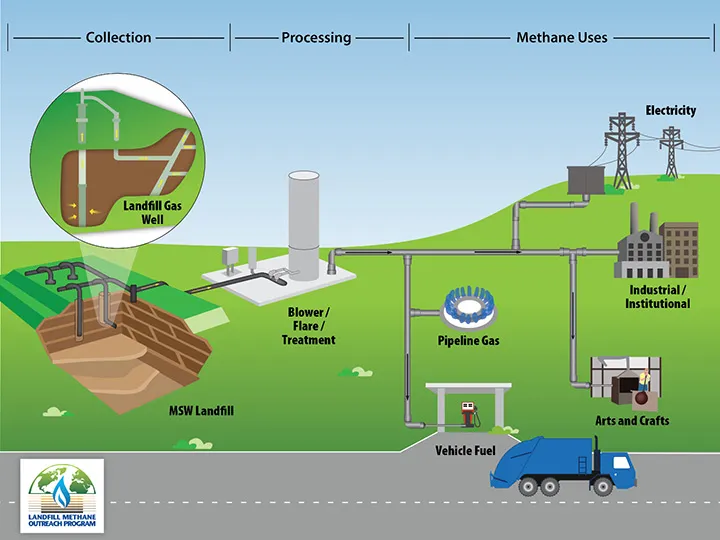
This is precisely where on-site bioenergy systems provide a structurally superior solution. Unlike grid purchases or REC instruments, bioenergy generation at the facility level produces a direct, auditable displacement of fossil-sourced electricity. When an industrial plant installs an anaerobic digestion system, a biomass combined heat and power unit, or a biogas-to-electricity system, it is generating electricity from organic feedstocks — agricultural residues, food waste, industrial organic byproducts — that would otherwise decompose and release methane into the atmosphere.
The emissions accounting for on-site bioenergy is transparent and defensible. Facility managers can calculate actual kilowatt-hours displaced from the grid, apply the regional eGRID emissions factor, and report a verified Scope 2 reduction. When biogas systems capture and combust methane that would have been released from waste streams, the avoided emissions calculation can extend into Scope 3 territory as well, providing additional credit under the most rigorous reporting frameworks.
For a facility in the Midwest consuming 40,000 megawatt-hours annually and displacing 60 percent of that load with on-site biogas generation, the Scope 2 reduction could exceed 10,000 metric tons of CO₂ equivalent per year — a figure that moves the needle meaningfully on any corporate emissions dashboard.
Regulatory Risk Is Accelerating the Timeline
Beyond investor pressure, the regulatory environment is tightening in ways that make grid dependency increasingly costly. The SEC's climate disclosure rule, while subject to ongoing legal challenges, signals a directional shift toward mandatory, standardized Scope 2 reporting for public companies. California's SB 253 and SB 261 have already established mandatory climate disclosure requirements for large companies operating in the state, including Scope 2 emissions. And the EPA's Greenhouse Gas Reporting Program continues to expand its scope and scrutiny.
Facilities that wait for regulatory certainty before acting on Scope 2 emissions will find themselves scrambling to retrofit both their infrastructure and their disclosures under conditions far less favorable than today's. The capital costs of bioenergy systems, the availability of federal incentives under the Inflation Reduction Act, and the current window for project development all favor early movers.
Turning Emissions Accountability Into Competitive Advantage
The most forward-looking industrial operators are not treating Scope 2 reduction as a compliance exercise. They are treating it as a competitive differentiator. Corporate procurement teams at major US retailers, automotive manufacturers, and consumer goods companies are increasingly requiring their suppliers to demonstrate measurable carbon performance. Industrial facilities that can document verified Scope 2 reductions — backed by on-site generation data rather than paper credits — are better positioned to retain and grow those relationships.
At Sri Balaji BioEnergies, we work with industrial clients to design bioenergy systems that are engineered not only for energy output but for emissions accountability. Every system we deploy is built with the reporting infrastructure needed to translate kilowatt-hours of clean generation into defensible, auditable carbon reduction metrics.
The hidden carbon cost of grid dependency is no longer hidden. It is visible in your ESG rating, in your investor conversations, and increasingly in your regulatory filings. The facilities that act decisively today will not merely meet their sustainability commitments — they will define the standard others are measured against.