When Every Acre Counts: How On-Site Biogas Outmaneuvers Solar and Wind for Space-Constrained Manufacturers
For the majority of America's industrial manufacturers, the renewable energy conversation begins and ends with a familiar constraint: space. A food processing plant in the Chicago suburbs, a pharmaceutical manufacturer in New Jersey's dense industrial corridor, or a mid-sized automotive supplier operating on a legacy urban site in Detroit — none of these facilities have the luxury of deploying dozens of acres of solar panels or erecting wind turbines across open terrain. And yet, clean energy mandates, rising utility costs, and ESG accountability are pressing harder than ever.
The result is a growing mismatch between the renewable technologies most commonly marketed to industry and the physical realities most industrial operators actually face. Solar and wind dominate the national conversation, and for good reason — they have transformed utility-scale energy generation. But utility-scale assumptions do not translate cleanly to a 12-acre manufacturing campus with loading docks on three sides and a stormwater retention basin on the fourth.
This is where on-site biogas systems are quietly rewriting the rules — and where Sri Balaji BioEnergies believes the industry's most underappreciated clean energy opportunity currently resides.
The Land-Use Math That Changes the Conversation
To understand why biogas holds such a structural advantage on constrained sites, it helps to examine the raw numbers around energy density and spatial requirements.
A commercial-grade solar installation typically generates between 5 and 10 watts per square foot of panel surface, depending on panel efficiency, geographic latitude, and orientation. Translating that into meaningful industrial capacity requires significant acreage. A facility seeking to offset 1 megawatt of electrical demand through solar alone would need approximately 5 to 10 acres of unobstructed, south-facing surface — figures that exclude mounting infrastructure, maintenance access corridors, and the inevitable shading losses from adjacent structures.
Wind energy presents an even more acute spatial challenge in industrial settings. Turbines require not only substantial setback distances from buildings and property lines — often 500 feet or more — but also consistent, unobstructed wind corridors that urban and suburban industrial sites almost never provide. The practical reality is that utility-compatible wind generation is simply off the table for the vast majority of American manufacturing facilities.
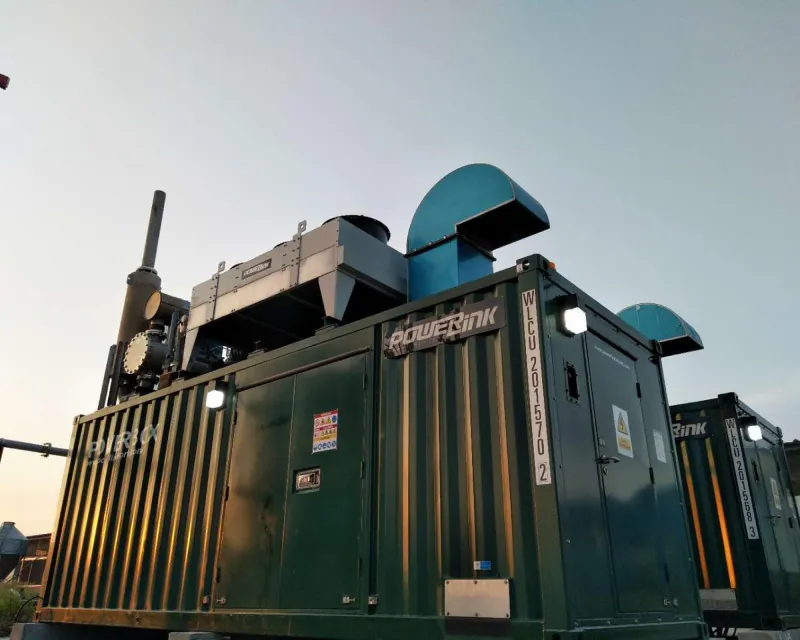
Biogas systems operate under an entirely different spatial logic. The core infrastructure — anaerobic digesters, gas conditioning equipment, and combined heat and power (CHP) generators — can be engineered to fit within a remarkably compact footprint. A well-designed on-site biogas system capable of generating 500 kilowatts of continuous electrical power, plus recoverable thermal energy, can often be housed within less than half an acre of dedicated equipment space. Critically, that output is not subject to the intermittency penalties that reduce the effective capacity of solar and wind installations.
Continuous Output vs. Intermittent Generation: Why the Distinction Matters for Manufacturers
The energy density comparison becomes even more compelling when intermittency enters the calculation. Solar panels generate power only during daylight hours, with output varying significantly based on cloud cover, seasonal sun angles, and temperature. Wind turbines produce energy only when wind speeds fall within their operational range. Both technologies require either battery storage systems or grid backup arrangements to deliver the consistent, 24-hour power supply that industrial operations demand.
Biogas systems, by contrast, generate electricity and heat continuously — 24 hours a day, 7 days a week, across all seasons and weather conditions. For a manufacturer running three shifts, operating cold storage, or maintaining temperature-sensitive production processes, this distinction is not merely academic. It translates directly into energy reliability, reduced grid dependency, and a simplified infrastructure equation that does not require expensive battery arrays to bridge generation gaps.
When calculating the true effective output of a renewable installation, industrial energy planners must account for capacity factors — the ratio of actual energy produced to the theoretical maximum. Utility-scale solar in the US achieves average capacity factors between 15 and 25 percent. Wind averages between 25 and 45 percent depending on site conditions. Biogas CHP systems routinely operate at capacity factors exceeding 85 percent. On a per-square-foot basis, that continuous, high-capacity output is transformative for facilities where every kilowatt-hour of offset carries financial and operational weight.
Real ROI Scenarios for Tight-Footprint Facilities
Consider a mid-sized meat processing facility in the Midwest — a sector that generates substantial organic waste streams and operates energy-intensive refrigeration and processing equipment around the clock. A facility of this profile producing 50,000 pounds of organic waste per day has the feedstock potential to support a biogas system generating between 400 and 700 kilowatts of continuous electrical power, plus significant recoverable heat for process applications.
The capital investment for such a system, after applicable federal Investment Tax Credit (ITC) benefits and state-level incentives, typically falls in the range of $3 million to $5 million depending on system complexity. Against annual energy cost savings of $600,000 to $900,000 — combining electricity offset, thermal energy recovery, and avoided waste disposal costs — simple payback periods of four to seven years are achievable. Over a 20-year operational horizon, net financial returns in excess of $8 million are realistic for facilities in this category.
A comparable investment in solar, constrained by the same facility's limited rooftop and ground-mount availability, might offset 15 to 20 percent of electrical demand — a meaningful contribution, but one that leaves the majority of the facility's energy costs and emissions profile unaddressed. The biogas system, operating within a smaller dedicated footprint, can realistically offset 60 to 80 percent of total energy consumption when thermal recovery is fully integrated.
The Waste Stream as a Strategic Asset
One dimension of the biogas advantage that rarely receives adequate attention in comparative analyses is the dual-stream value proposition. Unlike solar or wind installations, which require only sunlight or wind as inputs, biogas systems transform an operational liability — organic waste — into a productive energy asset.
For food and beverage manufacturers, agricultural processors, breweries, dairy operations, and pharmaceutical facilities, organic waste management represents a significant and often growing cost center. Landfill tipping fees have risen steadily across most US markets, and regulatory pressure on organic waste disposal is intensifying in states from California to New York. A biogas system does not merely generate clean energy; it fundamentally reclassifies the facility's waste stream from an expense to an input, compressing the effective cost of energy production and strengthening the overall financial case.
This waste-to-energy integration also strengthens ESG reporting metrics across multiple dimensions simultaneously — reducing Scope 1 emissions from waste decomposition, offsetting Scope 2 emissions from grid electricity consumption, and demonstrating circular economy principles that resonate with investors, customers, and regulatory stakeholders alike.
Rethinking the Renewable Hierarchy for Industrial Applications
The national clean energy narrative has, understandably, been shaped by the technologies best suited to utility-scale deployment. Solar and wind deserve their prominent role in that story. But industrial energy managers operating on constrained sites must resist the temptation to apply utility-scale assumptions to facility-scale decisions.
For the manufacturer with 15 acres, significant organic waste output, and a genuine need for continuous, reliable clean energy, biogas is not a compromise or a consolation prize. It is, by most meaningful metrics, the superior solution — delivering higher effective energy density, continuous output, waste stream monetization, and a financial return profile that holds up against rigorous scrutiny.
At Sri Balaji BioEnergies, we work with industrial clients across the United States to evaluate their specific site conditions, waste profiles, and energy demands — and to design biogas systems that maximize value within the physical constraints that define real-world manufacturing operations. The methane advantage is real, and for space-limited facilities, it may represent the most consequential clean energy decision available today.