From Waste Stream to Bottom Line: How America's Largest Corporations Are Profiting from Biogas
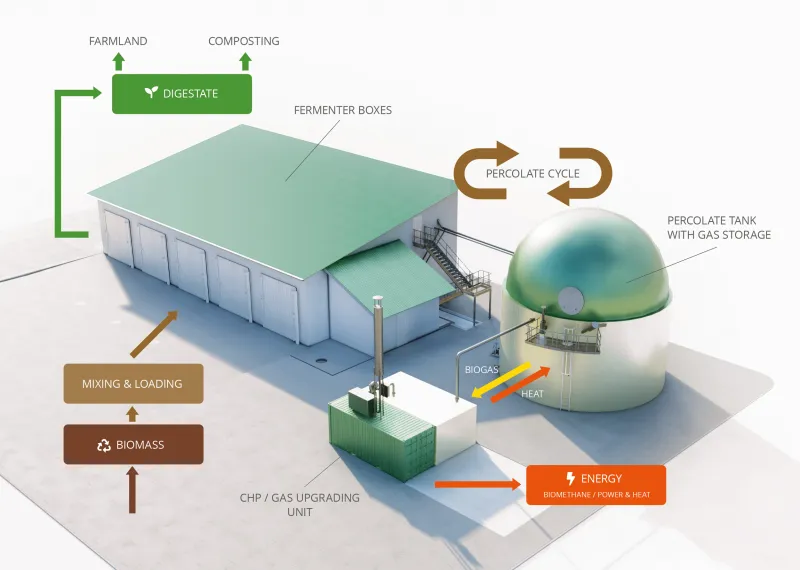
Photo: industrial biogas anaerobic digestion facility corporate manufacturing plant, via www.renergon-biogas.com
For decades, sustainability initiatives in corporate America were largely viewed as a reputational investment—valuable for public relations, but rarely expected to generate meaningful financial returns. That calculus is changing rapidly. Across the industrial landscape, from food processing giants in the Midwest to pharmaceutical manufacturers on the East Coast, biogas technology is emerging as one of the most strategically sound energy decisions a large corporation can make.
At Sri Balaji BioEnergies, we work with industrial clients who are navigating precisely this transition. What we observe consistently is that the companies achieving the greatest returns are not those who adopted biogas as an afterthought—they are the ones who treated it as a core operational strategy from the outset.
The Financial Architecture of Biogas Adoption
Understanding why Fortune 500 companies are accelerating their investment in biogas requires unpacking the multiple revenue streams and cost-reduction mechanisms the technology provides simultaneously.
First, consider energy cost displacement. Industrial facilities that generate biogas on-site—typically by capturing methane from organic waste, wastewater treatment processes, or agricultural byproducts—can offset a substantial portion of their natural gas or electricity purchases. For a mid-sized food manufacturing plant consuming 50,000 MMBtu of natural gas annually, even a 30 percent displacement through on-site biogas generation can translate to savings exceeding $500,000 per year at current market prices.
Second, and often underappreciated, is the avoided waste disposal cost. Many industrial operations pay significant tipping fees to dispose of organic waste at landfills or wastewater treatment facilities. When that same waste becomes a feedstock for an anaerobic digester, the disposal liability transforms into an energy asset. Companies in the meat processing and dairy sectors, in particular, have found that this dual benefit—energy generation plus waste cost elimination—dramatically accelerates their return on investment timelines.
Third, renewable energy certificates (RECs) and low-carbon fuel standard (LCFS) credits in states like California provide additional monetization pathways that can contribute meaningfully to project economics, sometimes adding tens of thousands of dollars in annual revenue per project.
Real-World ROI: What the Numbers Actually Look Like
The skepticism that sometimes surrounds biogas investment often stems from an overemphasis on upfront capital costs without adequate consideration of the full financial picture. A well-designed anaerobic digestion system for an industrial facility typically requires an initial investment ranging from $2 million to $10 million, depending on scale and complexity. That figure can cause hesitation in capital planning conversations.
However, when modeled across a 15-to-20-year operating horizon—which reflects the realistic lifespan of modern biogas infrastructure—the economics become compelling. Multiple case studies from US industrial operations document simple payback periods of five to eight years, with net present values that comfortably exceed initial capital outlays when incentive structures are properly leveraged.
One illustrative example involves a large-scale brewery operation in the Pacific Northwest that installed an anaerobic digestion system to process its spent grain and wastewater. The facility achieved a payback period of approximately six years, reduced its natural gas consumption by 40 percent, and eliminated nearly all of its organic waste disposal costs. The system continues to generate cost savings and carbon credits more than a decade after commissioning.
Similarly, a major food distribution company in the Southeast integrated biogas capture into its cold storage and processing operations, using the generated energy to offset refrigeration costs—one of the most energy-intensive aspects of that industry. The project's ROI exceeded initial projections by nearly 15 percent, driven in part by rising grid electricity prices that made on-site generation increasingly valuable over time.
Navigating the Technical and Financial Barriers
Despite the clear financial logic, biogas adoption at the industrial scale is not without genuine challenges. Companies that have struggled with their transitions typically encountered one or more of three core barriers.
Feedstock variability is perhaps the most technically demanding issue. Biogas production depends on a consistent, high-quality supply of organic material. Industrial facilities whose waste streams fluctuate significantly in volume or composition—due to seasonal production cycles or product line changes—must invest in more sophisticated digester designs and monitoring systems to maintain stable output. Proper feasibility assessment and system engineering at the outset are essential to avoiding underperformance.
Project financing complexity presents another hurdle. While federal investment tax credits, USDA Rural Energy for America Program (REAP) grants, and state-level incentives can substantially reduce net project costs, navigating these programs requires expertise. Many industrial finance teams are unfamiliar with the specific documentation and compliance requirements involved, which can delay project timelines or result in missed funding opportunities.
Regulatory permitting varies considerably by state and municipality. Air quality permits, water discharge regulations, and local zoning requirements all intersect with biogas project development in ways that demand experienced guidance. Companies that engage permitting specialists early in the planning process consistently report smoother and faster project delivery.
Why the Strategic Moment Is Now
The convergence of several macroeconomic and regulatory trends is making this an exceptionally favorable moment for industrial biogas investment. Natural gas price volatility, which reached historic peaks in 2022 and continues to create budgetary uncertainty for large energy consumers, has sharpened corporate appetite for on-site generation and energy price stability.
At the same time, the Inflation Reduction Act of 2022 introduced and extended several tax incentives directly applicable to biogas and renewable natural gas projects, including enhanced investment tax credits and production tax credits that materially improve project economics for US industrial developers.
Corporate sustainability commitments are also creating internal demand pressure. As Science Based Targets initiative (SBTi) commitments and Scope 1 and Scope 2 emissions reduction goals become standard expectations from institutional investors and major customers alike, biogas investment offers a rare opportunity to simultaneously reduce emissions and reduce costs—a combination that is difficult to achieve through most other decarbonization pathways.
A Strategic Imperative, Not an Optional Enhancement
At Sri Balaji BioEnergies, our perspective is straightforward: for industrial operations generating significant organic waste streams, biogas is no longer a peripheral sustainability option. It is a financially prudent, operationally sound, and strategically important investment that forward-thinking companies are acting on now.
The Fortune 500 companies leading this transition are not doing so out of idealism alone. They are responding to the same financial signals and operational pressures that drive every major capital decision. The difference is that they have recognized biogas not as a cost center, but as a competitive advantage—one that pays dividends in reduced energy expenditure, waste cost elimination, regulatory compliance, and long-term energy security.
For industrial leaders who have not yet conducted a serious feasibility assessment of biogas potential within their operations, the question is no longer whether the technology works. It does. The question is how much longer it is financially justifiable to delay.