Expansion Without the Emissions Hangover: Why On-Site Biogas Outperforms Grid Upgrades When Growth Is on the Table
The Growth Decision Nobody Is Fully Accounting For
Expansion is supposed to be a moment of optimism for industrial facilities — new capacity, new revenue, new market position. But behind every growth plan sits a quieter, more complicated question: where does the energy come from?
For most manufacturers, the default answer is the grid. Call the utility, request a load study, wait for the interconnection queue to clear, and eventually absorb whatever rate increase the expanded service agreement demands. It is a familiar process, and its familiarity makes it feel inevitable.
What that familiarity obscures is the true cost of the transaction — not just in dollars, but in carbon. Grid infrastructure upgrades carry a substantial and widely underappreciated emissions burden, one that directly undermines the sustainability commitments that many of these same manufacturers are publicly championing. The good news is that distributed biogas systems offer a credible, scalable alternative that facility planners are beginning to take seriously — and for compelling reasons.
What Grid Expansion Actually Costs in Carbon Terms
When a facility requests a significant increase in grid capacity, the utility doesn't simply flip a switch. Substations must be upgraded or replaced. Transmission lines may need to be rerouted or reinforced. Transformers, switchgear, and metering infrastructure all require manufacturing, transportation, and installation. Each of these activities carries embodied carbon — the greenhouse gas emissions generated during the production and deployment of physical materials before a single kilowatt-hour of electricity is ever delivered.
Steel, copper, aluminum, and concrete are among the most carbon-intensive materials in modern manufacturing. A large substation upgrade can require hundreds of tons of these inputs. According to lifecycle analyses of electrical infrastructure, the embodied carbon footprint of a single substation modernization project can range from several hundred to several thousand metric tons of CO₂ equivalent, depending on scale and regional grid characteristics.
This figure rarely appears in utility proposals or interconnection agreements. It is invisible to most facility finance teams and entirely absent from standard environmental impact assessments at the project level. Yet for a manufacturer working toward Scope 3 emissions reductions or trying to maintain credibility against a published net-zero target, this hidden carbon liability is anything but trivial.
The Timeline Problem Compounds the Damage
Beyond the carbon math, grid upgrade timelines create a compounding problem for expansion-minded facilities. Interconnection queues across the United States have grown dramatically over the past several years, driven by the simultaneous surge in renewable generation projects and industrial load growth. The American Clean Power Association has documented average interconnection timelines stretching beyond four years in some regional transmission organizations.
For a manufacturer that needs expanded energy capacity to support a new production line or an electrified process upgrade, a four-year wait is not merely inconvenient — it is strategically paralyzing. During that window, competitors may capture market share, capital sits idle, and the facility may resort to temporary diesel generation to bridge the gap, adding yet another layer of emissions liability to the ledger.
The timeline cost of grid dependence is a form of opportunity cost that rarely appears in capital planning spreadsheets, but its effects are entirely real.
How Biogas Infrastructure Changes the Equation
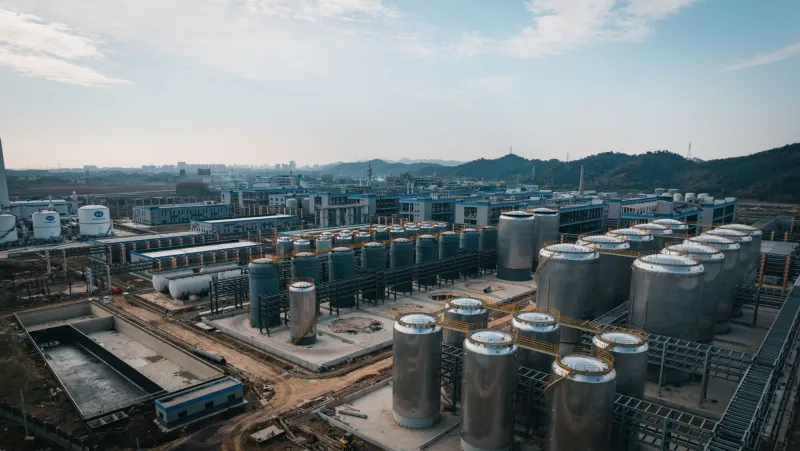
On-site biogas systems take a fundamentally different approach to the energy expansion problem. Rather than drawing more power from an already-strained external grid, they generate energy from organic waste streams already present at or near the facility — food processing residuals, agricultural byproducts, wastewater treatment solids, or industrial organics that would otherwise require disposal.
The infrastructure required to build a modular anaerobic digestion system — digesters, gas handling equipment, combined heat and power units — carries its own embodied carbon, as all physical systems do. But the critical distinction lies in what that infrastructure replaces and what it produces over its operational life.
A well-designed biogas system displaces grid electricity and thermal energy simultaneously, reducing the facility's ongoing carbon intensity from day one of operation. It does not require waiting for a utility's interconnection queue. Permitting and construction timelines for modular biogas installations typically run twelve to twenty-four months — significantly faster than major grid upgrade projects in most jurisdictions. And because the system is located on-site, it eliminates the transmission and distribution losses that reduce the effective efficiency of grid-delivered power.
When you account for the avoided embodied carbon of grid infrastructure, the displaced operational emissions over a ten-to-fifteen-year system life, and the methane capture benefit from organic waste that would otherwise decompose aerobically or be incinerated, the lifecycle carbon advantage of biogas over grid expansion becomes difficult to argue against.
Building a True Expansion Cost Framework
Facility planners evaluating energy strategy for a growth project should consider adopting a total carbon cost framework alongside the traditional financial analysis. This means accounting for the following variables when comparing grid upgrades to distributed biogas:
Embodied carbon of infrastructure: Quantify the upstream emissions associated with the physical materials required by each option. Utility upgrade projects should be evaluated using published lifecycle emissions factors for electrical infrastructure components.
Operational emissions over the planning horizon: Model the ongoing carbon intensity of each energy source across a ten-to-fifteen-year period, including projected grid emission factors under various scenarios. In regions where the grid is decarbonizing rapidly, the calculus may shift; in regions with high coal or natural gas dependence, biogas holds a stronger advantage.
Methane avoidance credit: Organic waste streams that feed a biogas system would otherwise release methane — a greenhouse gas with roughly eighty times the warming potential of CO₂ over a twenty-year period — through landfilling or open storage. Capturing and combusting that methane provides a carbon benefit that should be included in any honest comparison.
Timeline-adjusted carbon exposure: Factor in the emissions generated during the delay period associated with grid upgrades, including any temporary generation sources used to bridge the gap.
Regulatory and incentive alignment: The Inflation Reduction Act's investment and production tax credits, USDA biogas loan and grant programs, and state-level renewable portfolio incentives all favor on-site biogas deployment. These financial offsets reduce the effective capital cost of biogas infrastructure and improve its carbon payback period.
The Strategic Clarity That Comes From Honest Accounting
The conversation about industrial energy expansion has for too long been dominated by a single question: what is the cheapest way to get more power to this facility? That framing made sense in an era when carbon had no price and climate commitments were voluntary marketing exercises.
That era is ending. Regulatory pressure, investor scrutiny, customer expectations, and the growing materiality of carbon pricing mechanisms are all pushing industrial operators toward a more complete accounting of what energy decisions actually cost — not just on the income statement, but on the balance sheet of environmental impact.
At Sri Balaji BioEnergies, we work with industrial clients to develop expansion energy strategies that hold up under both financial and environmental scrutiny. Biogas infrastructure is not the right answer for every facility or every growth scenario. But for manufacturers that generate meaningful organic waste streams and face genuine grid capacity constraints, the combination of faster deployment, lower lifecycle emissions, and improving economics makes distributed biogas a serious contender — one that deserves a seat at the table before the utility call is made.
The hidden carbon cost of grid upgrades is not going to stay hidden much longer. The facilities that build their expansion strategies around that reality today will be better positioned for the compliance and competitive landscape that is already taking shape.